(1910) Mikhailov 2013-07-11

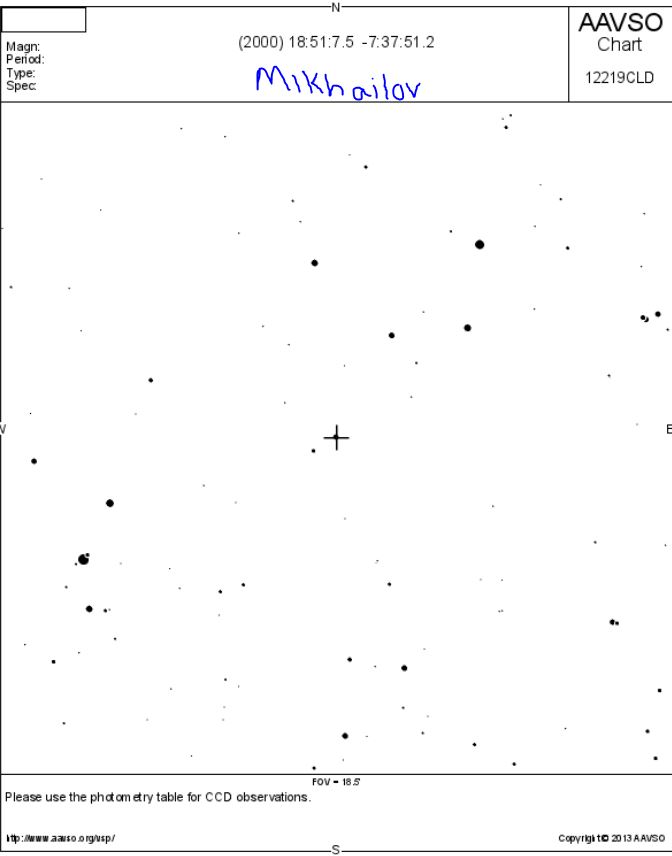
AAVSO @ 18.5'

AAVSO @ 18.5′

The above chart is oriented to match the view of the field through the CPC-1100 with diagonal

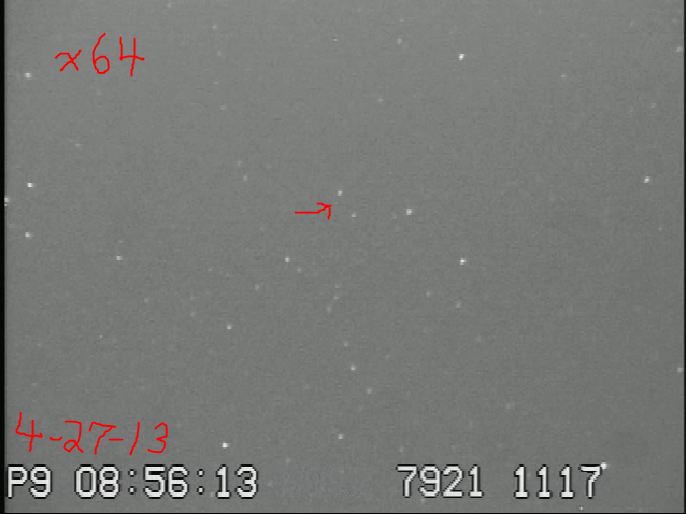
Sense-Up x16

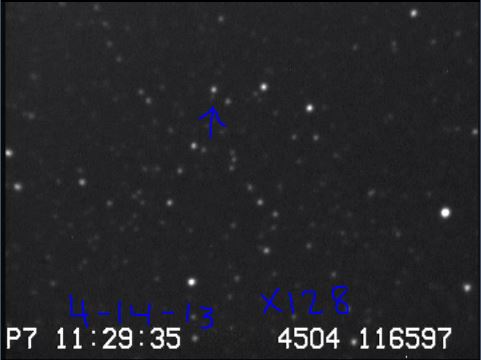
Sense-Up x16

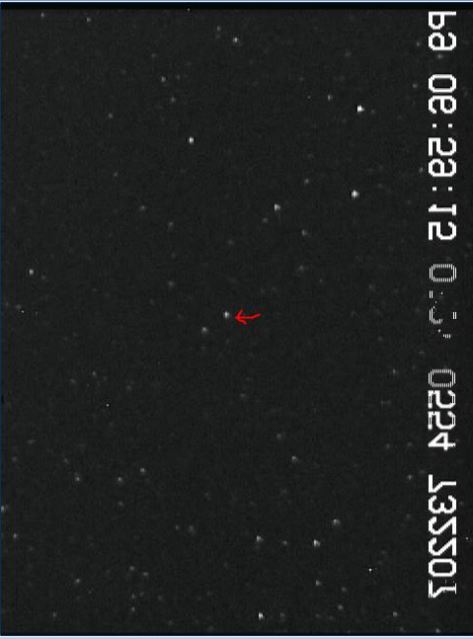
The above image matches the AAVSO chart above. The reason the numbers are mirrored is because the Carson City scope does not have a star diagonal. However, we wanted to present the image as “you” would observe it.

NOTE: Chart Rotation may be need to “match” your field


Three Occultations Targeted for July

Happy Fourth of July!

2013_July_Maps_small

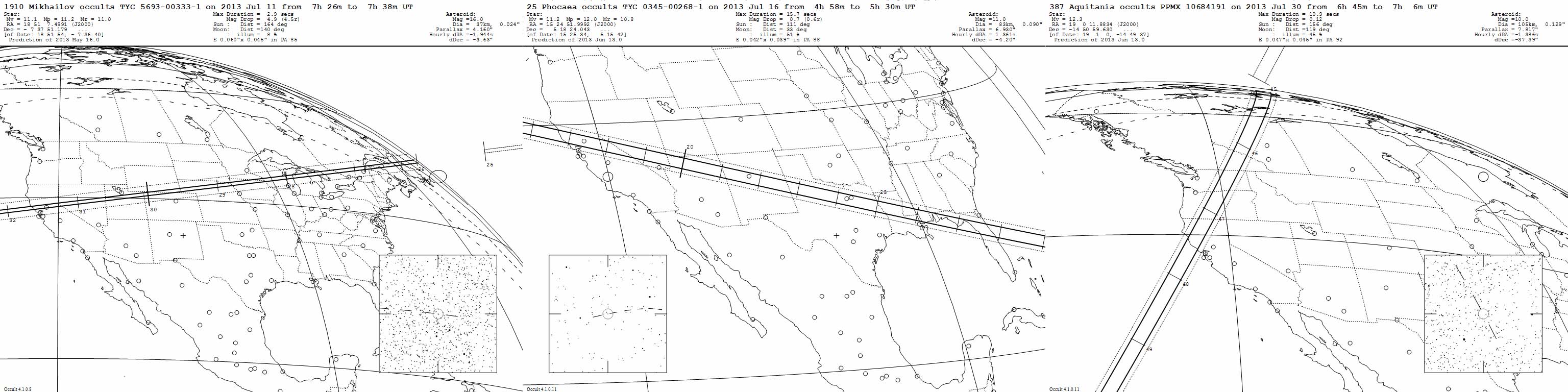
This month, the RECON network will be observing three different occultation events involving Main Belt Asteroids.  Because we know the orbits of these objects better than TNOs, the predicted uncertainties for the shadow paths are lower.  While all in the network are welcome and encouraged to participate and practice on all three events, we are specifically asking smaller subsets of the network to record data so that we can demonstrate the ability of the RECON to detect three occultation events this month.  Events are summarized below along with links to the information page for each:

2013 July 11, (1910) Mikhailov – CENTRAL region (Burney/Fall River, Susanville, Greenville, Quincy, Portola, Reno, Carson City, and Yerington)

2013 July 16, (25) Phocaea – SOUTHERN region (Reno, Carson City, Yerington, Hawthorne, Tonopah, and Bishop)

2013 July 30, (387) Aquitania – NORTHERN region (Burney/Fall River, Cedarville, Tulelake)

Please don’t hesitate to post questions and thoughts on this blog using the “Leave a reply” link below or by going to the individual event pages linked above!

Preliminary Reports from First Campaign

This past weekend, fifteen telescope sites associated with RECON coordinated to collect data from a predicted occultation by Pluto. The most recent predictions prior to the event placed Pluto’s shadow in the Southern Hemisphere, but this occultation provided a good inaugural opportunity for the RECON network. While we are still in the process of confirming data collected from the network, preliminary reports back from each site indicate both successes as well as lessons learned. Below is a summary of preliminary reports:

Six of RECON teams were able to successfully get on the Pluto star field and record data during the predicted times. Given the challenges of the Pluto’s location low on the eastern horizon, this is a significant accomplishment!

Two teams were able to record data but got on the field about 10 minutes late. This is not surprising because Pluto was just rising and was very low in the eastern horizon, so there was limited time to get on the field.

One team faced cloudy conditions but was still able to do a three star alignment through holes in the cloud cover. The team also did a “precise-goto” and got near the Pluto field and start their recorder, but the clouds never cleared in the target region.

The remaining six teams dealt with various issues both in and out of their control and were not successful in recording data but learned good lessons. These involved making proper adjustments to the camera gain control, re-centering the telescope on the target field, dealing with mountains and trees on the horizon that blocked the rising star field, fighting power failures associated with a design flaw in the power connection for the CPC-11, and explaining to concerned passers-by what folks were doing out with telescopes at 1AM.

All in all, things went very well for this first observation campaign. There were great lessons learned and with just a little more time and practice we would have had at least eight and likely even more scopes on the field for the event. Also, I just received email confirmation from Marc that the occultation was detected at Cerro Tololo Inter-American Observatory (CTIO) in Chile. Marc will provide more details next week when he is back from Brazil.

Great job all!!! Feel free to add additional details of your experiences as a reply to this blog post.

AAVSO charts

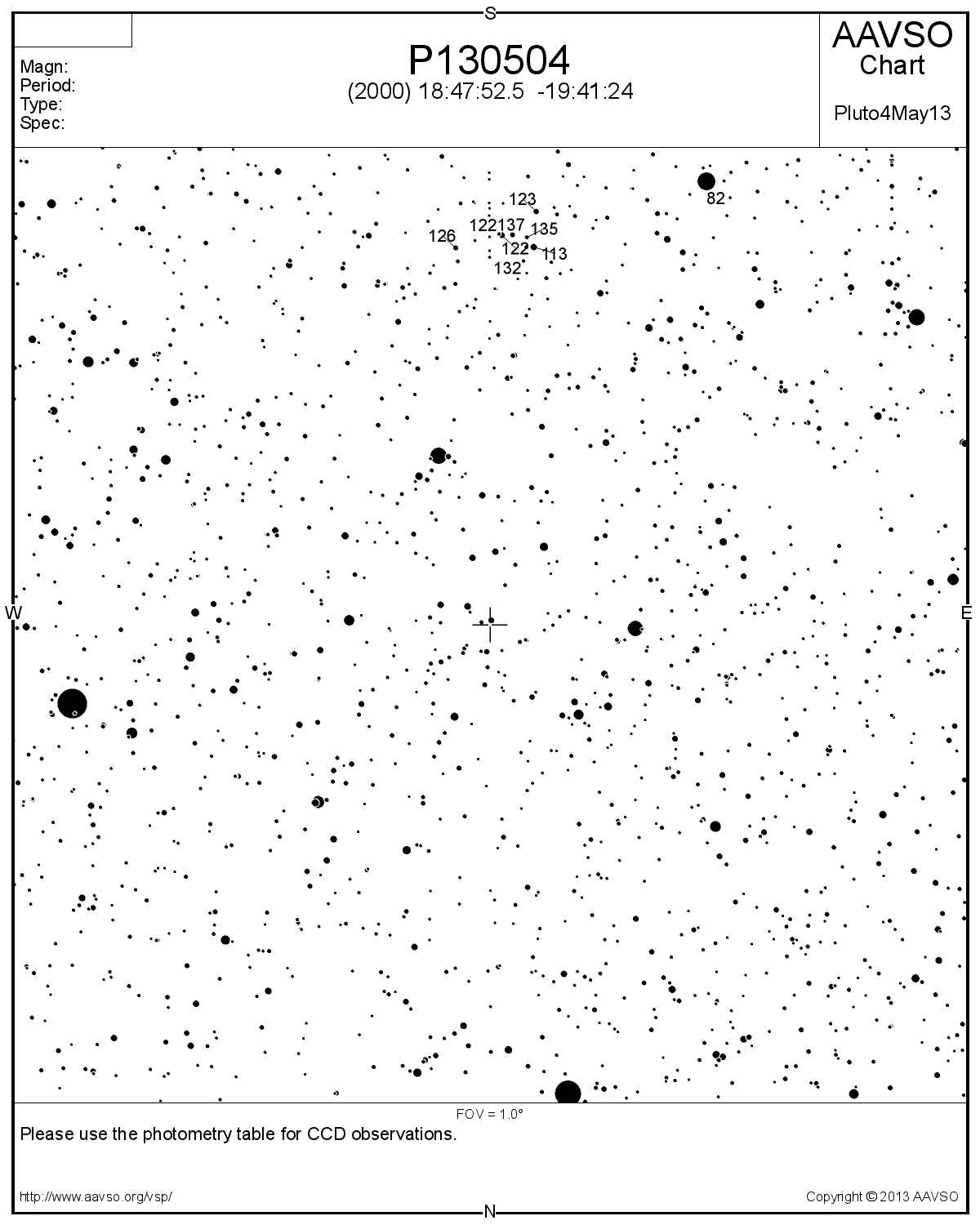
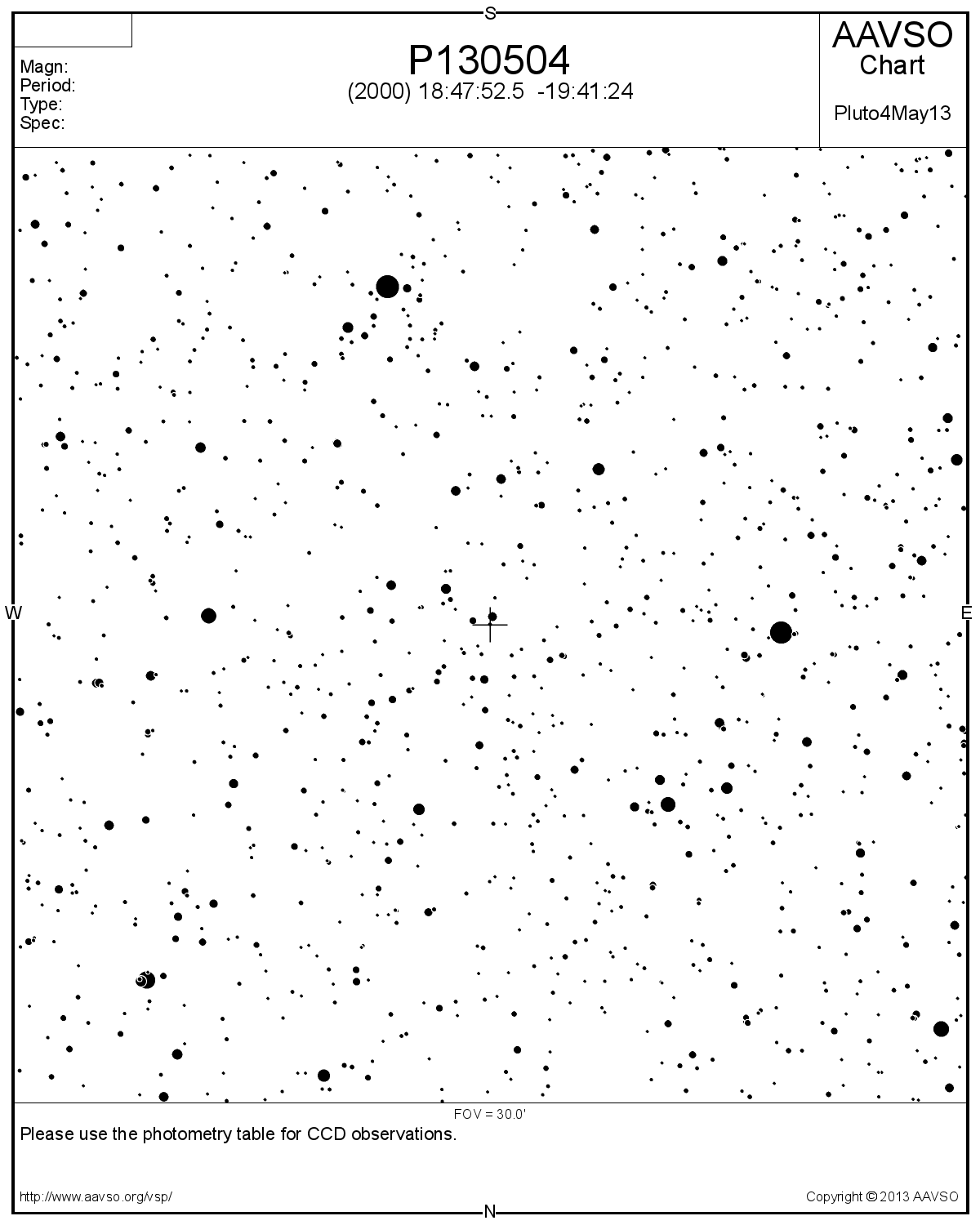
I found that the AAVSO charts that were posted for the Isolda event were a useful adjunct to the others provided from asteroidoccultation.com.  Here are three similar charts for the upcoming Pluto event.  If you want to make your own, visit http://www.aavso.org/vsp and set your own parameters.  This is also an easy way to make charts that are reversed or in another orientation.

The 1-degree chart only goes to 14th magnitude so the target star is not shown, but the other two go to 15th magnitude.
— Charley Arrowsmith

1degree   30minutes   18.5minutes

Isolda lessons learned

For those of you that tried Isolda, thank you.  Seems like most of us had one difficulty or another but it’s good to get that our of our collective systems early.  I haven’t had a chance yet to review all of the files uploaded.  I really have to get this automated more.  Being on the road non-stop isn’t helping either.  Last week I was in Flagstaff for a Planetary Defense Conference.  Saturday I was at the bottom of Meteor Crater.  Today I’m in Baltimore serving on an advisory committee for the Hubble Space Telescope.

I wanted to share some reflections on last week’s Isolda occultation event.  First, I have to apologize for one of my mistakes here.  I didn’t check on the Moon for this event.  It was really close and pretty bright on event night.  It gave me a lot of trouble with getting setup and finding the field.  I was not really able to use anything on the star hop list fainter than Alhena.  If it wasn’t for PreciseGoTo I would not have found the field at all.  In the end, the moonlight caused me to take longer than anticipated to get on the field and I was very rushed for time to get the data recorder started.

Aside from the obvious reminder lessons floating around that night, I learned something really important about our cameras.  The concept is a little tricky to explain but the bottom line is that if you use an exposure time (senseup) that is too short, you can fail to detect your object at all.  That meant x12 was a really bad idea.  Kudos to the Carson City folks in figuring this out and running with x48 instead.

Here’s the details in case you are wondering.  I took a lot of data a couple of weeks ago getting ready for the Pluto event.  Normally you can take an image with one set of camera parameters and then scale to what you’d expect to see at other settings.  I do this all the time, even for working with the Hubble Space Telescope.  In our case, this calculation doesn’t quite work right, as I found out. You see, today’s digital detectors are a lot more capable than cameras were at the time the video signal standard (NTSC in the US) was developed.  Video is designed for a fairly limited range in brightness, far less than what a good camera can deliver.  That means you have to do something in the electronics to match the camera signal to the video output.  This is normally labeled “brightness” and “contrast”, same as you’d see on an old TV.

If you were designing the perfect system, there would be a control that would let you set the signal level for the background of your image.  There’s always some background, either it’s from the sky brightness directly or it’s from the noise floor of your detector.  Now, you can think of a video signal as having 256 levels of brightness — 0 would be black, 128 would be grey, 255 would be white and you have shades in between.  I always prefer to see my background.  That means I’d set the background to be a signal of 5 to 10, depending on how noisy it is.  That means any source in the sky you can detect will be seen as a brighter bump on the background.

Our MallinCAMs have other ideas about how to set the background, unfortunately.  Now, I have to say that there’s a chance I just haven’t figured out how to configure them to do what I want but with my current recommended settings this is a problem to watch out for.  As I was saying, the MallinCAM doesn’t have a problem with black sky (signal=0).  That’s what I had for the Isolda event.  The problem with this is that you can’t tell the difference between a signal level of -100 and -1.  It all comes out as 0.  So, not only could I not see the sky but the star to be occulted was at a signal level below 0 and I only got a few of the brightest stars in my field.

How do we deal with this issue?  I’m not entirely sure yet.  I can say that x64 for the upcoming Pluto event is safe.  I really need to characterize the camera better so I know how to better predict its output.  This will be an ongoing effort in the coming months.  All of you could help if you like and I’ve also got a couple of bright high school students that are going to work on tasks like this as soon as school lets out.

Oh yes, there’s one other thing that I’ve noted.  The DVR screen makes your images look darker and less useful than they really are.  I put an example of this on the Pluto event page.  This makes it a little tricky to ensure that you are really seeing the sky level when you are in the field.

Determining Orbits

Portola RECON member Warren asked for more details about how I go from images to orbits for the TNOs we’re interested in. Let me explain.

Most people know that planets, asteroids, and TNOs all orbit the Sun.  The force of gravity keeps everything bound together into what we know as the solar system  Remember about Kepler and Newton? From their work we have a mathematical theory that describes motion under the force of gravity. If you have just two objects, like the Sun and a single TNO, this simple theory can perfectly describe the motion of these two, forever. The path the TNO takes through space is called its orbit. Now, in our case, we really care more about the mathematical description of its motion. Kepler’s mathematical formalism requires the determination of six parameters at some specific time. Those parameters collectively are known as orbital elements and consist of the semi-major axis, eccentricity, inclination, longitude of the ascending node, longitude of perihelion, and the mean anomaly. From these values it is possible to calculate where an object is at any time.

Ok, so that’s the perfect setup. What’s it like in real life? First of all, you can’t just divine or even directly measure any of the orbital elements. Second, there are far more than two objects in our solar system. Here’s where it starts to get tricky (and sometimes interesting, but that’s a story for another day). Let’s just worry about the first part for now. What can we measure? Well, our most useful instrument is a camera. With this we get an image of the sky that contains stars, galaxies, and perhaps our TNO at some known time and from some known location. Most, if not all, of the stars and galaxies will be objects whose positions are already known. These are known as catalog objects and are used as positional references. Using the catalog objects we can calibrate the correspondence between a position in the image to the coordinates on the sky (known as the celestial sphere). Most of the time this is rather simple. You work out the angular scale of the
image (arc-seconds per pixel) and the sky coordinate of the center of the image. From that you can then calculate the sky coordinate of any pixel.  When you work with wide-field cameras there are often distortions in the image that need to be mapped out. Ok, so you see you TNO on the image and then compute its position. This position, known as right ascension and declination, is a pair of angles measured from a single reference point on the sky.

Having a single position is not good enough yet to compute an orbit.  Not only do you need to know where it is but you also need to know its velocity (speed and direction). With perfect data, you could simply wait some time from your first picture and then take another.  These two positions now give you a measure of the velocity. There’s a
catch, though. First, you never have perfect data. That means your limited in what you can learn in just two measurements. There’s something you cannot easily measure from just two positions. On the sky you get a good measurement of the sky position and the velocity as seen in the sky.  You do not have good information on how far away it is or how fast it
is moving toward or away from you. A clever guy named Vaisala figured out a trick for working with limited data like this.  His trick was to guess what distance the object is at and you guess that it’s currently at perihelion. Perihelion is when the object is at its closest distance from the sun during its orbit. Unfortunately, with just two points there are lots of guesses that will give you a reasonable orbit but you don’t yet know which is right. Still, it can help you to pick something reasonable that can be used to predict where it will be the next few nights.

As you continue to make measurements (more images at later times), you build up what is called the “observational arc”. Formally, this is the time between your first measurement and your last measurement.  As this time gets longer, you can get better and better quality orbits.  By that I mean the orbit you think you have gets closer and closer to the true orbit. Now, what about that second thing I mentioned before?  Right, there are other things around than just the sun and the one TNO.  That means the position and velocity of everything in the solar system depends slightly on the position of all the other objects in the solar system. To get a perfect description you really need to have a catalog that is 100% accurate and complete. This isn’t very likely so we’re resigned to always having orbits that are really just approximations.  Are these good enough? In most cases, all you want to do is to find a TNO in your telescope again. That’s the easiest condition to meet.  If you want to see an occultation of a star by a TNO we need a very precise orbit. Finally, if you want to send a spacecraft to a TNO we need something extremely good.

You can make your orbits better in different ways. The easiest is to simply wait and then take another picture. Bit by bit as time marches on you will get a better and better orbit. How long you have to wait for a good orbit depends on where the object is in the solar system.  Objects closer to the Sun move faster and in so doing let you get a good orbit more quickly than a slow moving object. For a main-belt asteroid orbiting between Mars and Jupiter you generally get an excellent orbit (good for occultations) in just 4-5 years. Note that the one thing that does you no real good is to just take lots and lots of pictures.  Time is a lot more valuable than the number of measurements. In fact, on a single night you get the same information from 2-4 observations as you would from a thousand in one night. In the early days after discovery you need to observe more often but then things spread out considerably.  One rule of thumb I use is the “rule of doubling”. This rule says that you want to wait twice as long as your current observational arc before you both to measure it again. Here’s an example: you find a new TNO on some night with two images that are one hour apart. The third image should be three hours after the first image. The fourth should be at 6 hours, the fifth at 12, then at 1 day, 2 day, 4 day, 8 day, 16 day, 32 day, and so on. After a while you are waiting years or even decades for that factor of two. Now, this really isn’t a rigorous rule, after all, the Sun keeps coming up making it hard to see your object. Still, if you followed this rule you would never lose a newly discovered object.

Another way to get better orbits if you are impatient is to use a more accurate catalog. The quality of your positions for your TNO is only as good as your catalog. If you use a better catalog you get better positions. The problem is that this is really hard to do. We’ve got really good catalogs now but they could be a lot better. In fact, there is a European mission, named Gaia and planned for launch later this year, that will measure all the star positions to an unprecedented accuracy.  I can’t say enough about this mission. It will completely revolutionize occultation observations by making it very easy to predict where the asteroid shadows will fall. Alas, it’s going to be quite a few years before these results are available and work their way into better TNO positions.

A third way that works really well is to use radar. The Arecibo and Goldstone radio telescopes are used for this with near-Earth asteroids where they bounce a signal off the asteroid and analyze the return signal.  Radar is especially valuable because it can directly measure distance to the target and how fast it is moving toward or away from us. The problem is that the objects have be close. It’s just not practical to use this method on a TNO.

Now, think about sitting at the telescope and trying to get better orbits.  That’s what I was doing in March, 2013. I have information on every measurement ever made of a TNO (asteroids too, for that matter) and I know something about how good the orbit is. I’m looking for objects whose positions are poorly predicted that have not been seen in a while.  This is a very complicated thing to do at the telescope and I have some very powerful software that helps me keep track of what I’ve done and what I might be able to do as the night goes on. I can say that 3 clear nights on a big telescope can be a very exhausting experience but well worth the effort. Then, once the night is over there is the task of getting the positional measurements off the images. I’ll leave that discussion for another time.

Isolda event update

The Isolda event is tomorrow night for those of you interested.  I note that we’ve got one RECON site signed up for this.  I’m currently in Flagstaff and I will attempt the event as well, weather permitting.  The forecast here is for clearing conditions.  I’m waiting until closer to event time before signing up for a location to see who else will give it a try (IOTA or RECON).  If you do intend to observe this you really need to sign up on OW.  As more show up, the IOTA folks will hopefully treat it more seriously.  I posted a message to the IOTAoccultations group to try and drum up interest.

This event will be very interesting even if we only have a few of us doing it provided we also get some IOTA members to participate.  We will get our first chance to compared timing results from our cameras to the more well-tested systems that IOTA uses.

On the event page I have recommended a senseup setting of x12.  I have not actually used this on the field but instead have estimated the setting from other test data I’ve taken.  If I did this right the star will be there but not terribly bright in the image you’ll see.  If you just can’t see it, go slower to make sure but this is a good starting point.  I would like to ask those of you trying this with larger telescopes (12″ or 14″) to use a slightly faster senseup setting.  On a 12″ x10 would be the same as x12 on an 11″.  I don’t remember if there is an x10 setting or not, though.  If not, use x12.  For a 14″, x8 would be equivalent.  I think that’s a valid setting.  I’m interested in getting chords with different senseup settings to see if there is a change in the timing we extract that depends on the sense up setting.

Occultation Opportunity by Red Sumner, RECON-Carson

On 2013 April 18 between 0540 and 0542 UT ( Wednesday 17 April from 10:40p to 10:42p PDST ) the main belt asteroid 211 Isolda will occult a mag 12.2 star in Gemini for much of the RECON network. This is not an official RECON observation but is a great opportunity to practice what was learned at the workshop.
All sites north of Carson City except Reno and Quincy are in the predicted path of this event. Reno is 1.7 km and Quincy 3.3 km south of the predicted southern edge. A word about PREDICTED; if the orbit, asteroid size and orientation, and star position were all precisely known the path could be computed precisely. All of these parameters have room for error so there is the possibility of a shift from the predicted path. Sites inside the predicted northern limit could move outside or further inside; sites outside the predicted southern limit could move further outside or inside.  
What about the rest of us? Should Isolda have a satellite and it passed over a site they would record this satellite event; a possibility with a very low probability. 
The star charts attached below are to help you center the target star and are orientated as seen through your telescope with the RA & DEC on each chart. Stars to mag 14 are plotted; fainter than you are likely to see. Different locations will see the occultation at slightly different times but 10:40p to 10:42p will cover all the network. The 1st quarter moon 9 degrees away will add interest. 
I have tried to include all necessary info and to leave out many unnecessary details. As with many observation we will know much more after the event. Good luck.
Red  Sumner  
Star-Charts  60 min 30 min 18.5 min